
“In and Outside of How to Survive"
“In and Outside of How to Survive”
by Donald Nally
I first experienced Suzanne Bocanegra’s museum lectures on video – her Metropolitan Museum show, “Honor.” I found it compelling, informative, hilarious, and frightening. The riff on Hansel and Gretel is spectacular: how the Grimm Brothers’ tale references a 15th-c. situation reality of starvation and the killing of children families could not support; how Suzanne was obsessed with Hansel and Gretel’s dirndl and lederhosen, how she thought a house made of candy was an incredible idea. About the witch, she offers:
Have you ever wondered why she could conjure an edible house
but she still had to eat children?
There is an aspect of Suzanne’s show that particularly intrigued me. In it, Suzanne sits far upstage right reading the script quietly into a mic, while, downstage center, the actress Lily Taylor receives those words in her earpiece and speaks them as if they were hers. Suzanne even tells Lily when to press the button for a new slide to project on the stage-size screen behind her.
This raises all kinds of questions about a topic I’ve long found intriguing: how we listen, depending on who is speaking. Or, maybe, how our manner of receiving information is affected by our relationship to the speaker. But in my fascination is also the layers of storytelling going on in Suzanne’s concept, both magnified and rendered ironic by the visual picture of the author’s presence, having chosen to have another person speak as their voice. And, that other person is a celebrity. (This is not to say that Suzanne is not a celebrity; mention her in any art museum staff in the US or Europe and you’ll see that she is; but she can also safely walk down the streets of New York City without attracting attention.)
I got to thinking about The Crossing. Also, not a group requiring bodyguards, but a unit that could stand in for another unit – in fact, does stand in for another unit, regularly. They replace the composer as they bring a work to life, now sung by ‘something other’ than the creator. So, what if we created a piece in which Suzanne fashions a lecture, then we bring in intermediaries – the composers – that necessitate The Crossing’s presence. And then we sing, but we return the medium to its original form, which is to say, a museum piece, inspired by another work of Suzanne, in which a number of actors reenact the excruciating audition of Judy Garland for the 1960’s film Valley of the Dolls – a role she would not land. In that piece, visitors to the gallery may wander as they like among the various screens, getting close to one actor or another, or step back and take in the whole.
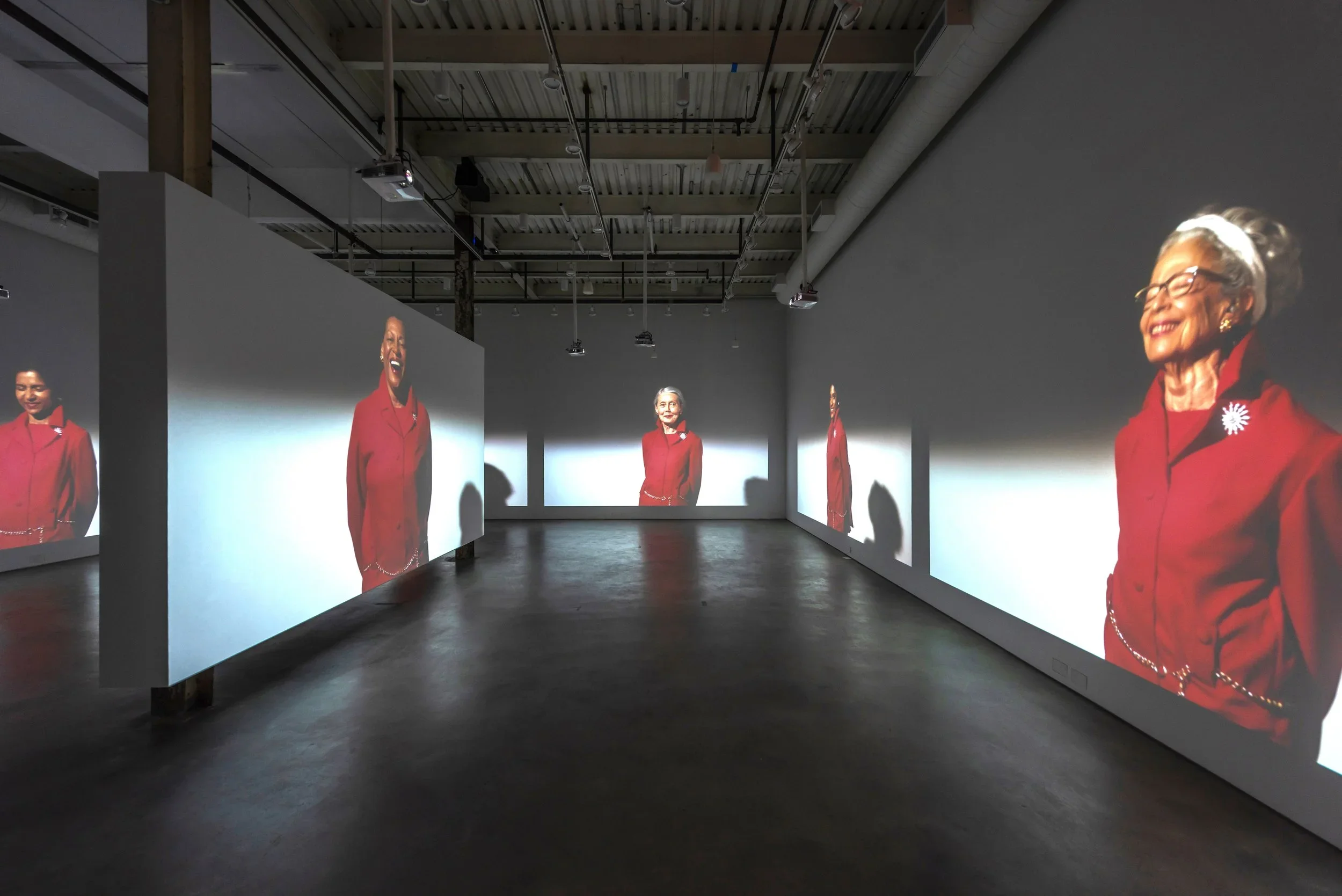
And, so we imagined a study in layers as the foundation of a new creative work that is a kind of hybrid choral work/film/museum installation with the kinds of layers that intrigue me about storytelling:
–Natural Disasters
–Suzanne’s Script Describing How to Survive Natural Disasters
–Composers Ayanna, Shara, Julia, Hildur Putting that through their Musical Lens
–The Crossing Singing that Music
–Paul Recording that Music, Adding His Art
–Evan and Kevin Filming that Music, Adding Their Art
–Installation Design and Decision-Making
–The Museum Visitor Receiving These Layers In a Gallery at the Fabric Workshop and Museum
I mention Installation Design and Decisions above almost in passing, but the layout of the room has been paramount in our many months of discussion; how visitors will navigate the room, experience singers life-size and far closer than they would ever be at a concert, “be with them” in the experience of singing. The singers are divided up into groups of 1-6, with the personnel of those groups constantly evolving, one singer migrating to another and another, so a visitor may consider, how do we receive this or that combination of personalities, this or that alignment of costumes. It’s almost un-Crossing-like in its focus on individuals, though, on the other hand, it is just one individual is onscreen that I am aware of the intensity of their listening and coordination with the collective.
And that’s part of the point. In addition to the many layers in this storytelling, we are also asking questions about the collective, in and outside of our piece How to Survive.
I had to add “our piece” to the above sentence, because it read as:
We are also asking questions about the collective, in and outside of how to survive.
At the end of the day, that question is fundamental to why we made this piece.